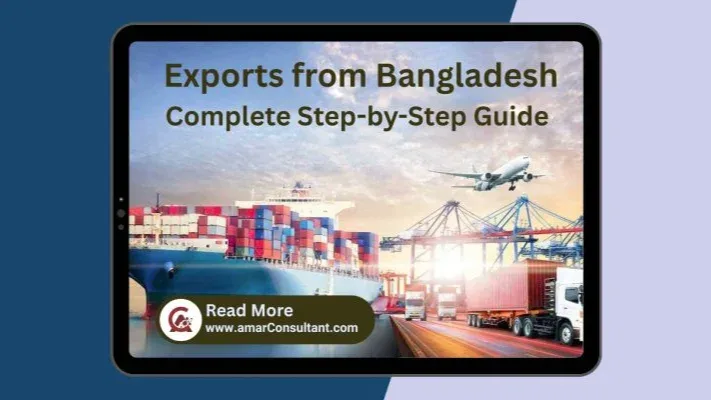
Step-by-Step Procedures of Exports from Bangladesh
1. Exporter Registration
Before initiating any export operation, a business must be registered as an exporter.
- Obtain an Export Registration Certificate (ERC) from the Office of the Chief Controller of Imports and Exports (CCI&E).
- Required documents include the TIN certificate, Trade License, Bank Solvency Certificate, VAT registration, and Memorandum of Association.
2. Product-Specific Licensing (If Required)
Some items require a special license or approval from relevant ministries or regulatory authorities — for example, pharmaceuticals, food items, or arms.
- Check the Export Policy Order to determine the applicable licensing requirements.
- Obtain a No Objection Certificate (NOC) or other approval if applicable.
3. Contract and L/C Opening
Export contracts are made between buyer and seller, often in the form of a Letter of Credit (L/C).
- Open the L/C through a commercial bank.
- Other accepted methods: Advance TT, Open Account, or Consignment basis.
4. Commercial Invoice & Packing List Preparation
Once the L/C is issued, prepare:
- Commercial Invoice
- Packing List
- Proforma Invoice
These documents are necessary for customs clearance and bank documentation.
5. Declaration to Customs — Export Entry
Fill up the EXP Form (electronic submission via the Customs ASYCUDA World system or the NBR portal) and submit it to Customs.
- Include the necessary shipping documents, L/C, invoice, and transport details.
- Obtain customs clearance from the port authority (e.g., Chittagong Port, Benapole, etc.).
6. Quality Certification (If Applicable)
- Products like food, garments, or pharmaceuticals may require quality certificates.
- Common certifying authorities: BSTI, the Department of Agricultural Extension, and the EPB.
7. Shipment of Goods
- Transport goods to port (sea, land, or air).
- Complete shipping formalities with a Freight Forwarder or C&F Agent.
- Get the Bill of Lading (BL) or Airway Bill (AWB) issued.
8. Realization of Export Proceeds
- The exporter must realize the foreign currency payment within 120 days of shipment.
- Payment comes via the L/C-issuing bank to the exporter's bank.
- Obtain a Proceed Realization Certificate (PRC) for tax purposes and incentives.
The PRC is a key document — it's required to claim cash incentives, bond facilities, and duty drawback.
9. Submission to EPB & Other Authorities
To qualify for cash incentives, bond facilities, or duty drawback, exporters must submit:
- Export documents
- Proceed Realization Certificate (PRC)
- Customs export reports to the Export Promotion Bureau (EPB) and the NBR
Disclaimer: This article is intended for general information and educational purposes only and does not constitute legal or financial advice. Export procedures, required documents, timelines, and incentive eligibility are governed by the Export Policy Order and the directions of the CCI&E, NBR, Bangladesh Bank, and EPB, and may change over time. Verify current requirements with the relevant authority or a licensed professional before acting.
Comments
Loading comments…